Showing posts with label Labor/Delivery. Show all posts

Wednesday, November 28, 2012

Big Decisions: Types of Providers


Hey future mamas!

As many of my friends in my community contemplate pregnancy or actually get pregnant, I'm thrilled to see that I've become a small but mighty source of information about making decisions in this process.  I love talking about it and I love helping people make educated choices about their health consumerism and their consumerism in general.  This week's posts are lovingly dedicated to multiple friends who shall remain nameless who asked me about this topic recently.  Best of luck to them and their partners in crime as they navigate these waters.

The decision of where to give birth wouldn't have even occurred to me as a decision until a couple years ago.  But as I began researching information about how to get pregnant, I realized that there were choices on where to be pregnant that I didn't even know existed.  I hope this week's posts will serve as a launching point for several of you who are doing your own research.

Types of Providers
A Doctor - This would typically be an OB/GYN but also could be a family practitioner, dependent on where you live.  They are typically affiliated with one hospital where they have "admitting rights" and that will dictate where you deliver.  OB/GYNs are surgeons by trade.  They are surgeons who have specialized in surgery required to deliver babies.  They are not typically well trained in natural child birth techniques, and are much more likely to recommend labor augmentation drugs, pain reducing medications like an epidural, and c-sections.  This is all, of course, statistically speaking, and should not be taken as a blanket comment about EVERY ob/gyn in the world.  They can provide both your prenatal care and your labor/delivery/recovery care.  Your insurance probably covers everything this provider provides.

A Midwife - There are two types of midwives... nurse midwives (CNMs) are trained first as nurses, then additionally as midwives.  In the state of MA where I live, they must practice in a medical facility (as opposed to in a home).  direct entry midwives are not nurses first.  They are more likely (in my limited experience) to work in people's homes.  Midwives are trained in vaginal childbirth.  They do not perform surgery, though they might perform small procedures like stitches necessary if you tear while giving birth.  They 'replace' the doctor in our typical view of pregnancy and childbirth... However, they are typically are affiliated with a doctor or facility who knows them well and will serve as a "back up" if your pregnancy or labor/delivery becomes high risk and you need more medical help than they are trained to provide.  They can provide both your prenatal care and your labor/delivery/recovery care.   Your insurance probably covers everything this provider provides.

A Doula - A doula is a completely separate type of provider.  I think it means "mothering the mother" in some language like Greek or Latin or something.  This person's job is not to deliver your baby, but instead is to help you through the process.  Think of them as a paid support provider similar to the role your husband or mother might serve.  They can be REALLY helpful, even if you have an active, involved husband and mother.  First, they have a wealth of knowledge that your husband and mother don't have because those people haven't attended hundreds of births.  Secondly, they probably know the venue and providers you're working with... so they can help you navigate the system while you're figuring all of this out for the first time.  And third, they are an objective 3rd party who can really help with decisions if you're in a rough spot.  Statistically speaking, women who hire doulas have FAR less c-sections than those who don't.  Your insurance probably won't cover this person, but the small amount they charge is totally worth it.  If I get pregnant again, I'm going to save up for a doula.  For sure.

Labor and Delivery Nurse - this provider is an 'assistant' to your midwife or doctor while you're in labor and delivery.  I didn't think they mattered too much when I was making decisions about where to give birth.  The thing is... on a busy night in the L/D unit, you might see more of this person than you do of your midwife.  And you CERTAINLY will see more of her than you'll see of your OB/GYN.  You don't get to pick this person.  You are picking a type of labor and delivery nurse by picking a facility.  So be sure to ask lots of questions about how L/D nurses act, provide care, etc while you're touring facilities to give birth in.  Ask how long their shifts are.  Ask how many patients they care for at one time.  Ask how they feel about drugs, lack of drugs, atypical positioning, intermittent fetal monitoring, etc... This person will become your/your husband's best friend or worst nightmare if you have a long labor/delivery.  Her services are covered by your inpatient hospital bill which is covered by your insurance.

Recovery Nurse - this provider is an 'assistant' to your midwife or doctor before you go home.  It might be the same as your L/D nurse if you're in a small facility.  Or you might not have one at all if you labor at home or in a small center and go home immediately.  I didn't think they mattered too much when I was making decisions about where to give birth.  The thing is... if you labor and deliver in a hospital and stay on the recovery unit for the average current stay of 2-3 days (4-6 for a c-section), you'll see a LOT of this provider... they give you your meds, they take your vitals, they check your bleeding, they make sure you do everything you're supposed to do before discharge... and they share a LOT of opinions while they do these things.  You don't get to pick this person (though you might be able to request the same nurse for several days in a row if you're lucky).  You are picking a type of recovery nurse by picking a facility.  So be sure to ask lots of questions about how nurses act, provide care, etc while you're touring facilities to give birth in.  Ask how long their shifts are.  Ask how many patients they care for at one time.  Ask how they feel about waking you in the night, caring for your child, co-sleeping while in the hospital, formula/breast feeding, etc, etc, etc.  Her services are covered by your inpatient hospital bill which is covered by your insurance.

Wednesday, April 25, 2012

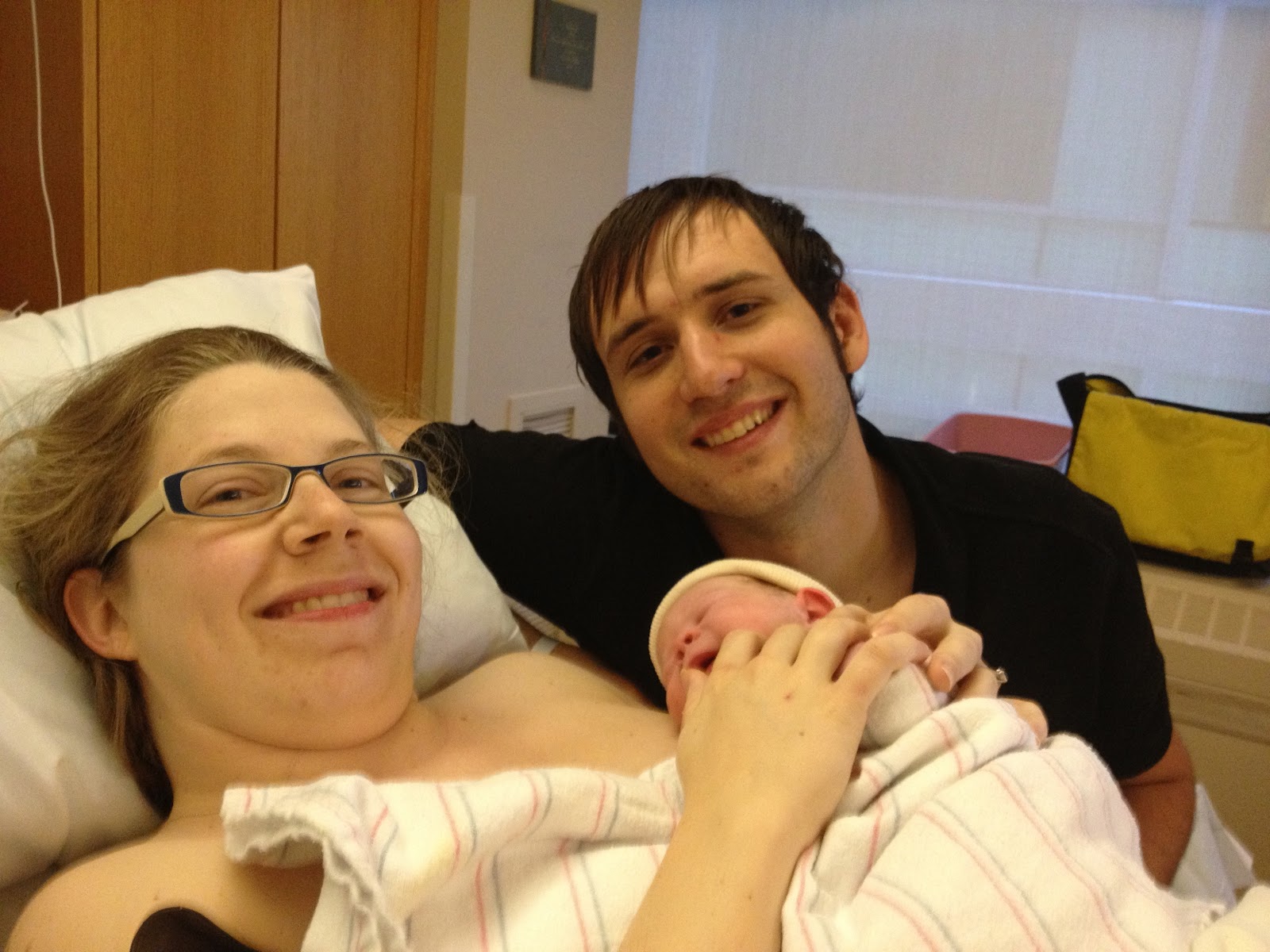
Olivia's Birth Story

Editor's note: this is long.  And probably just a first draft.  Having just finished writing it, I already am not happy with it.  It tells the order of events, but not much about the emotions or thoughts involved.  Expect edits.  

On Monday night, I was 40 weeks and 3 days pregnant.  And FRUSTRATED.  I'd had no less than 8 people at work say some version of "You're still here!" (Mental note: this is not what a pregnant woman wants to hear any time after 38 weeks.)  Super frustrating.  But my husband was amazing and we spent the evening together, just having some quality time, watching TV, hanging out.  But after the lights went out, I didn't sleep well.  I feel like I was up every 30 minutes or so (but refused to look at a clock).  My stomach hurt.  I tried to remember if I'd eaten anything that would give me intestinal trouble.  Ben snored.

By 4:30 am, I was awake enough that I decided I should look at a clock.  That would at least tell me whether or not I had enough time left to get any decent sleep before work.  And by 5:00am, I figured out that it wasn't just a stomach ache, these were contractions.  Was it the Evening Primerose I'd been taking? Or the red raspberry leaf tea kicking in?  They weren't very strong, but I figured I'd time them anyway.  Some women have light contractions for days, so I didn't really want to get my hopes up.  Ben snored.

At 5:30am, I got out of bed to go to the bathroom.  Standing made the contractions a little stronger.  I realized, while in the bathroom that our hospital bag wasn't completely packed... I'd gotten *most* of the stuff in days/weeks earlier, but had been lazy about finishing it up.  And I recalled our friends' recent story about her water breaking without a bag packed.  So I wondered if I could sneak around the bedroom and nursery quietly enough to not wake Ben but still finish packing the bag.  He'd been working hard recently, and if this really was labor, he'd need all the sleep he could get before things got serious.  Unfortunately, when I got back to the bedroom, I had a contraction and had to lean over on the bed... which woke my snoring husband.  He looked up (out of just one eye) and said, "did your water break?"

As soon as I told him what was going on, he snapped into action-- his first 2 actions included downloading a contraction timer app and feeding the fish a weekend feeder.  Completely hilarious in my opinion.  Those would have been the last two things on my mind.  We rushed around for a few minutes, tidying the house (only a little) and putting things in a bag.  My contractions still weren't very strong or long, but they came much more closely together when I was standing/walking than when lying down.  By 6:00am, Ben decided to call the midwife on call... which brought on the next funny story.  The answering service asks for information to page the midwife with -- name, date of birth, and what the problem is... Ben got so confused about "date of birth."  He thought they wanted Olivia's date of birth.  I had to help. :-)  Once we were talking to her, my contractions were anywhere from 2-6 minutes apart, only 20-30 seconds long, and I definitely could talk and breathe through them.  The midwife told us to hydrate, rest, and call back as things got moving along more strongly.  It also was convenient that I had a scheduled appt at 5:30pm that evening-- completely random chance.

After getting off the phone, we finished packing the bag up, showered, but eventually decided to lay down and rest.  I slept on and off for 2-3 hours-- probably got 1.5-2 hours of actual sleep during that time.  When we woke, Ben (my awesome labor partner) decided we should take a walk, so we went to JP licks for a muffin (for me) and a coffee (for him).  He was wonderful on the walk-- we went slow, he let me stop for contractions... he kept me entertained so I didn't think about them.

After eating a light lunch back at home, the contractions felt stronger... I convinced Ben to go to work for a couple hours-- if he didn't go soon, he wouldn't be able to make it back before the 5:30 appointment.  And if he went after the appointment, he might be too late to be helpful to the guys.  So he scurried off to the Museum of Science and I laid down to watch a little TV.  Once laying down, I could get the contractions slowed down significantly-- up to 11-15 minutes between them.  Occasionally they lasted 30-40 seconds, but typically only 20-30.  And still not so strong that I'd call anything painful.  Definitely uncomfortable and irritating.


When Ben got home from work, we packed up to go to the hospital appointment.  We decided to take our bag and the car seat with us "just in case," but both figured that my contractions were light enough that Jen would check me and send me back home to try to get some sleep for the night.  We got to the hospital early and I had a few contractions in the waiting room.  I paced a little and tried to breathe evenly so I didn't draw too much attention to myself.

At 5:30pm, they brought me in and the nursing assistant was stunned to hear I was in labor!  She took my vitals and went to get Jen.  When Jen came in, she said "You're famous!  I heard you called this morning 'cause you might be in labor!"  We chatted for a few minutes about whether or not I wanted her to sweep my membranes when she did my internal exam.  I'd declined a membrane sweep the Friday before (when I was exactly 40 weeks), 'cause Ben really encouraged me that my body would go into labor at the right time for us.  But on Tuesday evening, having had contractions for 12 hours, I thought a membrane sweep would be just fine to help progress things along.

Well, I'll be honest, I don't really know if she swept my membranes or not... I laid back on the table and she began to take a look.  The look on her face was the next funny moment.  She looked stunned.  I asked what was wrong and she told me that I was 5-6 cm dilated and 50% effaced.  I can't remember her exact words, but it was along the lines of "I don't know how you did that!"  I asked if it was good that I'd brought the bag and car seat with us and she said yes.  She told us we could go home if we wanted to, but she encouraged us to stay in the area instead... recommended we go to Harvard Square for some dinner and then come back to get admitted around 7:30pm.  On our way out, she asked if I'd done a lot of walking that day, 'cause if I hadn't she was worried that the walk to Harvard would get my labor progressing a lot faster.  Her two pieces of advice were "You don't have to go all the way, you can turn around any time and come back and they'll admit you.  And Amanda?  Don't worry, your baby won't fall out."  HA!  I guess she thought this thing was happening!  Jen happened to be scheduled for L&D on Weds from 8am to 8pm.  We'd joked for weeks about convincing Olivia to be born during one of her shifts.  On our way out the door she said, "Don't wait for me.  I'll come meet your baby when I get back in the morning."

On our walk to Harvard, we called all our families and told them the scoop.  I was walking a lot slower, but still walking through most of the contractions.  We went to Chipotle for dinner-- Ben got a burrito bowl and I munched off the edge of it while we sat outside (it was too warm inside, loud, and I was nervous to have contractions in front of so many people).  Before going back to the hospital, we also walked over to Peet's Coffee so that Ben could get an iced coffee for the evening.  A "celebration coffee" as he put it.

On our walk back, contractions were stronger.  I had to stop or slow down when they happened, I couldn't really talk, and you could tell from my face and body posture I was uncomfortable.  One occurred in the middle of a crosswalk, of course.  While stopping in the cross walk, a 60ish year old woman wheeled up on her bike, waiting for us to cross.  I looked up and apologized for being in her way.  She laughed and said "Wow.  You guys are in for some fun, aren't you?"

We made it back to Mt Auburn and to the L&D floor around 7:15pm-- Shift change for the RN staff.  When we walked in the door, about a million nurses looked up... "Um... I'm Amanda?  I'm in labor?"  One of them took us to our room.  At 7:30ish, the midwife (who was leaving at 8pm) came in and said hello, explained that Arianne was coming on duty after she left.  Between 7:15 and about 10pm, my contractions stayed pretty level.  Especially when someone else walked into the room (a nurse or midwife), I could almost ignore the contraction-- or at least outwardly didn't look too bad when it was happening.  But by 10pm, they must have been increasing in strength, I couldn't 'fake' comfort any more, and we decided to check to see how far along I was... only 7.5-8cm dilated.  It felt so disheartening to be 4-5 hours farther through this and only gain a few cms.  But there was nothing to do but wait.

By midnight (which brings us to Wednesday), contractions were definitely uncomfortable.  I needed encouragement to breathe through them.  I didn't like them.  And I didn't like the lack of rest I felt I got between them.  Getting in the bath tub made things a little more comfortable, but not a lot.  And at midnight, the nurse and midwife started saying things like, "you'd have your baby in your arms if you could just get your water to break."

I guess it was around midnight that I threw up for the first time.  (Don't read this paragraph if you're squeamish about vomit.)  I was in the tub and I kept saying I felt nauseous, but I don't think they believed me.  Finally I grabbed the pitcher that Ben had been using to poor water on my belly and just chucked right into it-- when I gathered my wits, I could tell that the full contents of my stomach including completely undigested burrito bowl was there.  As I passed it back to Ben and Arianne for dumping out, she gave him the thumbs up... this was a good sign that I was in transition.  I, being the annoying medical person that I am, mentioned that if I weren't in labor and had that much undigested food in my stomach 6 hours later, it would suggest a GI motility issue.  Just one little moment of clarity in my craziness that night. :-)

I guess it was around 1:00am that they wanted me on my hands and knees for a while, trying to open my pelvis and get my water to break.  I didn't want to do it because it was making my reflux bad to be leaning over like that... but they offered me an antacid, which helped some.

I spent quite a while at 9+ cms dilated.  But the positions that Arianne thought would help progress things were so painful during the contractions, that I was avoiding them.  At 2am, I really thought that Arianne was going to offer to break my water, but instead, she asked me to go sit on the toilet (my least favorite position) one more time.  It was in this position, squatting in the bathroom with Ben standing just in front of me for support, that my water finally broke.  I have to say, I cannot understand how this part of labor occurs for anyone while at work, in a mall, or while at a friend's house.  It felt like so much pressure and so much fluid (mind you, all over Ben's pants)... what the heck do you do if it happens while you're not naked in a bathroom at the hospital???

Unfortunately, after my water broke, I had some how regressed back to 8 cms.  :-(  Arianne suggested it was due to the pressure release from the water breaking.  Ben, on the other hand, thinks that the sphincter law and my dislike for the RN had something to do with it.  Regardless, after telling everyone for hours that I didn't want to do this any more (a classic sign of "transition"), Arianne asked me if I wanted to know what my options were for intervention.  I said yes, if only to decline them.  She said I was too far along for narcotics, but I could get an epidural.  "Okay then," I said, "we're not going to do that, so what's next?"  Back in the tub, Arianne suggested-- so back we went.

Arianne was, by the way, amazing.  She, of course, had to leave every once in a while to check on her other patients.  But she always seemed to be around at the right times.  And when there, she was such a wonderful help to me and to Ben.  She knew all the right things to say at the right times.  She took turns with Ben just holding my hand and rubbing my back.  She encouraged him to help me, she showed him good techniques.  And when he was feeling hopeless, she gave him energy to keep going with just an eye gaze and a few encouraging words.

I guess it was around 3am that I heard a couple nurses in the corner of the room talking about needing to get an IV into someone else down the hall.  Again, in a moment of clarity, I reminded Ben that the only real problem I'd had in my pregnancy was getting light headed/passing out when I wasn't hydrated.  And for hours, I'd been barely drinking anything, despite the RN telling Ben over and over that I needed to hydrate.  So I asked, "Do I need an IV?"  The RNs were like, "oh no, no, honey, we're not talking about you."  But Arianne said, "Did she just ask for IV fluids?  'Cause that's a good idea."

After they got the IV in (which ever RN did that while I was fussing and moaning through contractions, btw, gets a medal in my Amazing RN Book), I really felt like I couldn't help but start pushing.  But Arianne had told me not to push because I wasn't at 10 cms yet.  Ben thinks that this time, too, was confusing and frustrating for me (the rule follower), as I was sorta pushing but knew it was "bad" to push.  But finally at 4am, I was given permission to push!

Pushing.  Pushing means that you stop trying to breathe through your contractions and you start trying to use them to get the baby out.  Pushing means you hold your breath rather than encouraging yourself to breathe and stay open.  I had not practiced pushing.  I couldn't hold my breath long enough.  I couldn't get in the right position.  My body naturally wanted to arch away from my cervix and vagina rather than curling up toward it.  My pushing for the first hour was essentially completely ineffective.  But as we rounded into hour 2 of pushing (5am), the RN reminded me that the average first natural pregnancy pushes for 1-3 hours, so I was right on course.  We changed positions frequently, used the fetal monitor more than I wanted to, and the encouragement kept coming.

I guess it was around 6am that they brought the mirror in for me to watch what was happening.  Arianne said that seeing Olivia crowning would encourage me... let me tell you... seeing about 2 cm diameter of your baby's head when you know how big it actually is was not encouraging to me.  I turned away, closed my eyes, but I didn't refuse the mirror.  I thought that it would at least help Ben see what was happening while he stayed at the head of the bed with me.  By this point, I actually was really only comfortable on my back (as comfortable as you can be at this point) and got angry when I had to change positions.  So, we went with it-- and it was probably better for Arianne and the RN anyway.  The one problem, however, was that the RN and Ben were holding my feet differently and I spent a lot of time worried about pain in my right knee (the side that the RN was on) related to my knee surgery last year.  I recall being frustrated once I got my pushing technique improved... if this push didn't get her head farther out, what would really be different about the next push that would make it any better or more effective?  Arianne reminded me that Olivia had to move slowly down the birth canal, slowly stretch me open, and slowly prepare me for handling the entire width that she'd require to get out.

After her head came out far enough that it didn't keep slipping back in, I could watch in the mirror.  At that point, it was finally motivating to watch.  Unfortunately, at that point, it was also excruciatingly painful!  I shrieked like a child when the widest part of her head came through.  Ben cried.  The RN yelled at me, "Amanda!  You have to listen to Arianne now!!!"  But soon enough, the head was out.  This was one of the biggest moments for me-- put it in the category of seeing the little plus sign on the pregnancy test, hearing the heart beat for the first time, seeing the ultra sound, and feeling her kick -- there was a head between my legs.  It belonged to a human I'd never seen before.  In Ben's words, this shit just got real.

I don't really recall much of the next few minutes.  Ben says Arianne spun Olivia's head "like a top" and I remember her asking me to push again.  The next thing I knew, the head I'd seen between my legs along with a purple squid of a body was flopping against my chest.  6:55am, my daughter was born.

I don't know how long we hung in that moment... crying, saying "oh my goodness, oh my goodness."  It certainly didn't seem real.  The RN wiped her down... I remember asking "Does anyone have an apgar score?"  She had a 9, she was fine.

Another moment of clarity-- I asked Arianne what I should predict for the placenta.  And as if my body had known the perfect timing, it was then that I need to push just a little and it came out.  After the cord stopped pulsing, Arianne showed us the cord, how it wasn't needed any more, and helped Ben to cut it.  We got our "tour of the placenta," Arianne showing us the different parts, how miraculous it was... and we loved our baby.


In the next 15 or so minutes, Ben and I hugged and kissed little Olivia while Arianne took care of me with a few stitches.  And just as fast as this whole process started, poof- it was finished.  It was shift change time for the RN staff and Arianne had just an hour before the end of her shift to wrap things up.


And just like that, we were officially in the post-partum phase of life.

How do you tell your birth story?

I can't quite figure out what to do about telling my birth story.  In my day to day life (where I don't have *that* many friends that have given birth themselves), most birth-related stories are thought to be "traumatic," "horrible," "awful," etc.  I had arguments with friends (who'd never given birth, mind you) during my pregnancy who thought I was insane for wanting a natural child birth.  And since birthing, I've heard things like "I heard a story a couple weeks ago that made me NEVER want to have children," and "Oh good, now that you've given birth, I can tell you my horror story of my childbirth.  I didn't want to scare you before hand."

But having now been through a natural child birth, I can't really understand why we (we = the typical 21st century American woman) feel the need to dramatize childbirth SO MUCH that we convince those who haven't done it that it's impossible.  If you were to tell Rick and Dick Hoyt that it would be impossible for them to run a marathon, they might have believed you... or if you tell them that anything is possible, they might go run over 1000 races.  Perception is such an important part of each person's reality.

In preparing for my natural child birth, I spent a lot of time reading.  One thing I read was everything I could get my hands on by Ina May Gaskin.


This book was especially helpful at various points.  I read the 2nd half quite early in my pregnancy, learning about tips and tricks to reduce the pains of labor and encouragement to go naturally.  But the 1st half was meaningless to me early on.  It was full of people's birth stories.  

I didn't read the first half until the days just preceding Olivia's birth.  And I'd consider those stories to be the beginning of her birth story.  I knew all of the text book answers to how to promote a natural child birth.  I had all of the stages of labor memorized and all the info I needed to know for our birth plan was well laid out.  But as I reached 40 weeks pregnant, I wanted words of other women to inspire me.  So I spent my evenings (as Ben slept and I had insomnia) reading the stories in the front of this book.

Sure, some of these women had significant pain, some went to hospitals, others had home births.  Some labored for days and others popped their children out quickly.  But each story, in a different woman's voice, reminded me that we all can do it... we all are capable of this.  Our maker made us capable of this.  And it's a miracle.  A miracle I'll try to share with as many details as I can, including the physical pain and heart ache... but also with the amazing truth that the pain is irrelevant.

Sunday, April 1, 2012

Things to take to the hopsital

So I've read a lot of different sources on things to take to the hospital... and given that I'm 37 weeks pregnant, I thought maybe I should be starting my own list.  But I will be humble enough to admit that I have NO idea what I'm talking about here.  This is just a compilation of things that made sense from other sources.  So first of all, expect an "update" some day about whether or not any of these items were actually needed or useful.  And secondly, feel FREE to provide your input.  I've provided my own thoughts on the items too...

Paperworky Things
Insurance Card - not 100% sure I'll need this, since I've already pre-registered with Mt Auburn.  But it's always in my wallet, so doesn't really matter either way.
Hospital Paperwork - again, I'm pretty sure I've turned in everything in advance... but this might be important for other mamas out there at different locations
Birth Plan - my midwife and I talked about this last week.  We're both pretty sure that the vast majority of the things I want for my labor and delivery are "standard" with the midwives at Mt Auburn.  But I'm going to jot down a few notes for a) my own peace of mind and b) Ben's benefit.  That way he'll have the resource available if he, in a sleepy stupor, doesn't know the answer to any questions he's asked.

For the Labor/Delivery/Recovery Room (everything up to 2 hours post birth)
Chapstick - always a good idea, as the air in hospitals is generally dry.  And since I have about 100 laying around half completed, it won't be sad to "miss" one for the next couple weeks while it sits in the bag unused.
Music and connector - the LDR rooms at Mt Auburn are set up with CD players and have iPhone/iPod capability, but no cabling for it.  Not even 100% sure I feel the need to have music.  But it would be sad to not plan on this and then regret it.

For the Recovery Room (from 2 hours to 48 hours post birth)
Toiletries- personally, I'm not so picky.  And I know that the hospital will have some standard/generic stuff available.  But I'll probably throw in the most recent travel sized collection I have from a hotel, just in case.
hair brush - I only have 1 at home, so I can't pack it.  But I do have one I keep at work that I could bring home to pack.
Pajamas/Nightgown - this item is being tough for me.  First of all, everyone recommends it be something that you don't mind "ruining" by accident.  And then there's also the stipulation that I won't be back to my original pre-pregnancy size anyway.  So I'll probably pack my pregnancy sweats and a couple of older t-shirts that I don't care about as much.  I need to think about this more...
Non-slip socks or slippers - I wear my slippers at the house all the time.  They definitely couldn't go in a bag tonight and be unseen for the next 3 weeks.  I'll pack a couple pairs of socks though... but non-slip?  Huh-uh, don't have any.  I guess if I remember to throw the slippers in at the last minute, great.
Nursing Bras and pads
Underwear
Going Home outfit for myself - Needs to be comfy.  But also something that I don't mind wearing out in relative public.  Probably should be something that I fit into in the 3-6 month pregnant range.
Cell phone and Charger - of course can't pack now.  But I do have an extra charger that I typically leave at work.  I could probably bring that home and put it in the bag.
Pen and Paper - to write down questions between midwife visits, tips from an LC or RN, notes from the Pedi regarding how babygirl is doing, weights, etc.
Camera and charger - I know Ben will go crazy with his iPhone, but since I don't have one, I'll throw my camera down in the bag, just in case.
Extra pony tail holders - ya never know.  And they don't take up that much space.

Unsure about these items
Sanitary Napkins - Some things I've read suggest that the hospital will provide what I need and that I should leave these at home.  Others say take 'em.  Suppose it would be a good question for the midwife the next time I see her!
snacks - we know that the Mt Auburn hospital has a great cafeteria, good room service, and a large number of candy/snack machines available.  We also don't typically eat a ton of non-perishable, prepackaged snacks anyway (they tend to fall in the category of "food-like products" for us, which we try to avoid)... so I hate to buy a bunch of things that fall in the "snack" category just to waste them.  But maybe a pack of granola bars is a good idea???
Contacts and Make up??? - I think it's obvious why this is on the maybe list.  It's so "unnecessary."  But these pics will last a life time.  So if I could look good in a couple... it might be worth it.

For Ben
Clothes for two days
Pajamas

For Baby
Car Seat
Diaper Bag
Coming Home outfit
Receiving Blankets
Baby book??? - several sources suggest bringing it to put baby footprints in.  But I'm not even sure if the one I have has a spot for footprints- I need to look.  And on top of that, it might be just as easy to have them put on a piece of paper and add it to the book at a later date.

I don't think I'll take
A pillow - I'm not so attached to my pillows from home.  And the hospital will have pillows.  I'd rather not overpack.

What am I missing???

Wednesday, February 15, 2012

Delayed Cord Clamping

I could write an entire post on Delayed Cord Clamping and what I've learned.  I could describe what I feel are the benefits, many of which are at least peripherally highlighted in my other posts this week about vitamin K, eye ointment, and hep B.  I could site sources about animal birthing patterns, non-western culture, midwifes attending homebirths, etc, etc, etc.  But the truth of the matter is I'd be wasting my time and yours.  Instead, I'm just gonna highly recommend that you watch this video:

Delayed Cord Clamping Grand Rounds

It's a bit long (50 minutes total, I think), but worth every minute if you'd like to hear a real professional talk through the evidence base regarding when to clamp the cord, clinical benefits, and possible theoretical outcomes.  I learned SO MUCH.

If you take the time to watch, I'd love to hear what you think about it!  Also, tell me what your experiences are with cutting the umbilical cord!  Who did it for you?  When did they do it?  Was it something you thought about at all, or was it just 'routine?'

Monday, February 13, 2012

Saying No, Part III

Okay... when researching Hep B vaccines, I quickly got entrenched in dozens of sources fighting the battle of the standard vaccine schedule vs. various "alternative" schedules vs. avoiding vaccines all together.  And honestly, I haven't read enough about it to definitively make a statement pro or con about any of those 3 things.  So I'll keep things short and sweet, since I'm not ready to engage in the entire debate about vaccines.  Here's what I know thus far:
  • The standard vaccine schedule for children aged 0-6 (approved by the CDC and others) recommends 25 shots in the first 15 months of life.  Alternative schedules typically spread the same shots over 5-6 years.
  • The standard schedule of Hep B shots is given at birth, 1-2 months, and 6-18 months
  • Dr. Sears (the famous alternative immunization schedule guy) recommends Hep b at 2.5 years, 3 years, and 3.5 years instead.
  • most places require it for school entry (and require you to be on track for day care entry)
  • hep B, if contracted, is typically symptomless in infants, but still dangerous both to the carrier infant as well as anyone else they could expose 
  • Infant infections are typically found only in babies born to a Hepatitis B-positive mother (which I'm not), in which case it's important to get the vaccine in within 12 hours after birth.
I think that Ben and I will decline the Hep B shot while admitted at Mount Auburn, and this is approved by my midwife.  However, we will likely get our little girl the shot at some point in the future.  The question is whether we do it in the near future or the more distant future.  But I think the risks of Hep B certainly outweigh the consequences of pain from a few needles at some point down the road.  I'm really looking forward to figuring out what point down the road that is for us.  

I'll probably rely heavily on the advice of our pediatrician... which brings me to a whole separate issue.  Finding a pediatrician we like. ;-)

Sunday, February 12, 2012

Saying No, Part II

As promised, I wanted to talk more about saying no, specifically when it relates to labor and delivery.  I don't have as MUCH to say about eye ointment as I did about Vitamin K.  But I feel equally strongly about it.

Similar to my last post, I'm not going to include all of my citations here.  But I will let you know that this page at gentlebirth.org as well as some info at unhinderedliving.com was very helpful.  I'd strongly encourage you to do your own literature based, evidence based reading before you say no to anything yourself.

Eye Ointment
Why do all the pictures of 12 hour old babies always look a little greasy around the eyes?  Because for decades, it's been standard practice in the US (and many other westernized cultures) to use an eye ointment to reduce the risk of or prevent bacterial infections which could, theoretically, lead to infant blindness.  BLINDNESS?!?!  NOT COOL!  Most moms would hear that little information and say, "where do I sign for the eye ointment?"  But I'm sorta a black sheep when it comes to trusting medical professionals... I think it comes with the territory when you work in the medical field and learn how unscientific many of the 'scientific' things we recommend are.  Thus, I wanted to learn a little for myself.  He's what I've learned thus far:

  • gonorrhea and chlamydia can cause blindness in infants when they'd get exposed to the illnesses in the birth canal during delivery.
  • back in the day, the treatment for infants essentially included washing out the eyes with sterile water... you can imagine how useful that was.
  • In more modern times, if a child is infected with gonorrhea or chlamydia in their eyes, we'd treat them with antibiotics, which typically resolves the infection in less than a week.
  • The standard prophylactic for eye infections at birth used to be silver nitrate, but now the standard is Erythromycin... an antibiotic... wait, didn't we say in yesterday's post about vitamin K that antibiotic exposure would limit/reduce the uptake of vitamin K in a newborn?  hm...
  • Even if mom tests negative for gonorrhea and chlamydia (which, btw, I have multiple times in my life), physicians will still administer the prophylactic because sometimes screening tests for STDs are wrong/false negative.
  • Another "scare tactic" is that gonorrhea and chlamydia can lay dormant in a woman for years without symptoms... thus worrying us all that our children could get it in their eyes with no symptoms.  But it doesn't work that way.  If an infant gets an eye infection from gonhorrhea or chlamydia, you'd know immediately by their swollen, puffy, red, eyes and face.  One site even talked about "oozing."  Now what kind of mother would I be if I miss "oozing" from my child's eyes and face and don't take them IMMEDIATELY to the docs office for diagnosis and treatment?
Thus, given that I'm 100% positive that I'm in a monogamous relationship where neither my spouse nor I have either of these STDs, given that I plan to pay close attention to my child's eyes and face immediately following their birth (and probably for the next 18 years after that), and given that I don't believe in prophylactic antibiotics, I plan FIRMLY on declining the eye ointment at birth unless my midwife can make a REALLY good argument otherwise in the moment.  And at the present, my midwife agrees with me!


Stay tuned for part 3, where I discuss Hep B shots... 

Saturday, February 11, 2012

Saying No, Part I

Sometimes I think my "green" and "crunchy granola" personality gets hidden behind societal norms and my personality traits of "frugal" and "cheap-skate."  It's actually quite convenient that the two go hand in hand so often (except, sometimes, when buying organic groceries).  But I really have been motivated on saving our planets resources since I was a little girl.  I remember doing science experiments at home to see how long it would take rubber bands to rot away due to bad stuff in the air and having celery soak up food coloring to discover about how our plants are affected by what's in the water and the soil.  Did anyone else own this book: 50 Simple Things Kids Can Do to Save The Earth?  I think the cover's changed a few times since I was in elementary school.  But I will never forget that book.

So along with having to say no to myself about all sorts of things I want to buy, but don't, as we're trying to get out of debt, I am aware that saying no as a mother will be important too.  And I think it starts long before one's child is old enough to do something naughty.  As babygirl Warren grows and kicks more, I've been thinking about labor, delivery, and child birth and all of the things I might want or not want to be a part of that process.  You know I've been working with a midwife and my goal would be to have as natural of a birth as I can safely manage (though Ben swears at least one of us will be drugged for the process).  I'm not opposed to pain killers, epidurals, pitocin, IVs, fetal monitors, or even c-sections if my midwife thinks these are necessary to keep myself and my little one safe, but I'm not going to pursue them as "the standard" like many American women do.

Along with that, there are a variety of medical interventions that Americans perform/do/provide to their infants within the first few hours of life that I am wondering if I should say no to as well.  I had a chance to talk with my midwife about these at Thursday's appointment.  And I'll be honest, even though I knew I was working with a "crunchy granola" midwife, I was pleasantly surprised at how quickly she told me it was okay to say no.

The first one she said I could say no to was really more of a "maybe," which I think is fair.  It is: VITAMIN K.  In the US (and many other western countries) babies are given a shot of Vitamin K during the first few hours of life to help with blood clotting.  I was concerned, though, because I believe the research that outlines how you want to minimize traumatic experiences as much as possible with little ones, especially brand-new-day-one little ones.  A shot, no matter how routine, is a traumatic, painful event.  So I wanted to look into the whats and whys of vitamin K shots-- to determine if it's really necessary.  Here's my own brief summary of what I learned:

  • Vitamin K shots became common in the 40s (when "twilight sleep" labor was common) when most women were so knocked out that they had to use forceps to deliver the baby and therefore, head traumas were very common.
  • Vitamin K literature is skimpy with regard to what the "right" dose should be -- it's never been thoroughly tested
  • The only reason they give it by shot (rather than by mouth, which has been shown in the literature to be effective as well) is to "ensure that the baby actually gets it."  Really?
  • Babies often "loose" or "miss out" on 40% of their blood volume at birth by clamping and cutting the umbilical cord immediately after birth (rather than waiting until it stops pulsing, about 5 minutes).  
  • The reason people clamp and cut so early is so that they can take the baby across the room, away from mom, to perform other interventions... many of which have to do with being in distress because there's not enough blood (do you start to see the circular reasoning here???)
  • Vitamin K is passed to the baby better in breastmilk/colostrum than it is through the placenta.  However, many babies aren't nursed immediately and miss out on the early doses of colostrum which are high in Vitamin K.
  • Vitamin K uptake is reduced/limited when mothers or babies are exposed to antibotics during 3rd trimester or labor/delivery
I read a lot of websites and articles, but I won't bother siting them all here.  My favorite one was at gentlebirth.org if your curious to read it in someone else's words.  But if you're really considering saying No yourself, I'd also encourage you to look at something with evidenced based citations, which that site is missing.

So, when I asked my midwife about skipping out on vitamin K, her response was that it was reasonable if I don't have a traumatic birth (aka, if I don't need a c-section, forceps or vacuum delivery, lose a lot of blood, baby immediately in distress, etc-- all those things that I am hoping not to need anyway).  She said that Mount Auburn would administer it (if we consented) after the baby was taken to the nursery for her exam and bath and Ben went with her, so Ben would have to know what our plan was.  I thought that was all quite agreeable. 

Having researched it now, my hope (but not expectation.  I know I can't expect perfect) about vitamin K is that 
  • I have an easy, natural birth without trauma,
  • Baby is well enough that she can stay with me for at least the first 5 minutes until the cord stops pulsing before we cut it,
  • Baby is well enough to stay with me for the first 2 hours in the labor/delivery room so that we can start nursing ASAP,
  • and therefore we'll be able to decline the vitamin K shot.
On a related note, I also found conflicting information about ways that mom can consume vitamin K to best help baby.  A couple places talked about how vitamin K isn't passed well through the blood, so there's not much I can to do help.  But a couple other places talked about how increasing my vitamin K could help.  One source discussed a small study in ?Norway where they tested vitamin K levels during the 3rd trimester, which were gradually dropping in all of the women, presumably because the baby was taking the vitamin k that he/she needed, leaving low levels for mom.  

Now I'd say, even if the vitamin K doesn't pass through my blood to my baby, I still don't want low vitamin K levels for myself... I need good clotting too, right?  I mean, first of all, I've always bruised easily, second of all, I'm gonna have a lot of blood loss during labor/delivery, and 3rd, it can even contribute to silly little things like increased gum bleeding when I floss!  Thus, I want to keep my vitamin K levels high, if I can.  So the first thing I did was look at my prenatal vitamin... not a single drop of vitamin K in it!!!  I was stunned!  If we're in such a rush as a society to give it to baby immediately after birth, why aren't we, as a society, trying to pump it in during pregnancy?  That led me to looking for other, more natural ways to get vitamin K. And really, if I'm eating well, I should be getting plenty of vitamin K. Take a look at this list of vitamin K rich foods:

"Excellent sources of vitamin K include parsley, kale, spinach, Brussels sprouts, Swiss chard, green beans, asparagus, broccoli, kale, mustard greens, turnip greens, collard greens, thyme, romaine lettuce, sage, oregano, cabbage, celery, sea vegetables, cucumber, leeks, cauliflower, tomatoes, and blueberries."

Again, I won't bore you with ALL the links I looked at, but this site seemed to be a pretty good summary of what vitamin K is, what it's helpful for, how to get it, etc.


What vitamins and minerals are you most on the look out for in your diet???


p.s., next post - eye ointments and hep B shots for newborns... stay tuned!